


Global companies are no longer looking only at large, multi-function GCCs. A newer, sharper model is gaining traction — Nano GCCs, compact centers that focus on high-impact capabilities with smaller, expert-driven teams.
And India has quickly become the world’s strongest launchpad for this model.
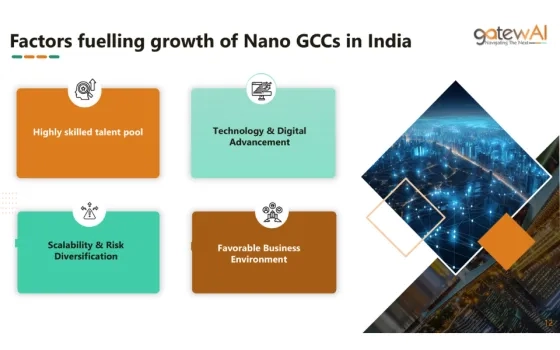
But what exactly is powering this shift? Here are the four biggest drivers behind India’s Nano GCC momentum — explained in a more detailed, engaging way.
The true backbone of Nano GCCs is talent — and India’s talent advantage is unmatched.
India brings together professionals skilled in:
This mix allows companies to build small and young teams that deliver big outcomes.
Even a Nano GCC with 10–40 people can operate with the same level of specialization as a traditional GCC — thanks to India’s deep talent density, strong technical education ecosystem, and growing culture of innovation.
Simply put: Nano GCCs built small, but their impact is big.
India’s digital ecosystem has transformed dramatically. From AI labs and cloud-native startups to advanced cybersecurity practices, the country has built an environment where innovation can happen quickly — and cost-effectively.
This digital maturity reduces experimentation cost and accelerates innovation — making India a natural home for agile, high-tech Nano GCCs.
One of the biggest reasons companies prefer Nano GCCs is the freedom to scale at their own pace.
This reduces financial and operational risk.
Nano GCCs also support risk diversification — companies can distribute operations across locations, strengthening resilience and ensuring continuity even during global disruptions.
In a world where agility is everything, Nano GCCs give companies a smarter, lower-risk way to build capability.
India’s policy landscape has significantly powered the Nano GCC wave.
Initiatives like Digital India, Startup India, and improved ease-of-doing-business norms have made India one of the most efficient and economical destinations for setting up capability centers.
This policy environment gives global enterprises the confidence to build long-term capability centers — even at a smaller, more focused scale.
The Big Picture
Nano GCCs represent more than just a “small GCC model.” They symbolize a shift in how companies build global capabilities:
And India, with its talent strength, digital backbone, and pro-business environment, is perfectly positioned to lead this next chapter in global capability building.
As the world moves towards agile, tech-driven operations, Nano GCCs in India are setting a new benchmark for speed, efficiency, and innovation.
Conclusion
The rise of Nano GCCs is not just a trend — it’s a strategic evolution. Companies are realizing they no longer need large teams to achieve global impact. What they need are focused, skilled, innovation-ready units, and India offers the perfect foundation for this shift.
With unmatched talent, advanced digital capabilities, a supportive policy landscape, and a scalable operating model, India is becoming the global epicenter for the next wave of capability centers.
As enterprises rethink their global strategies, Nano GCCs will play a central role in shaping future-ready, resilient, and innovation-led operations — with India leading the way.