


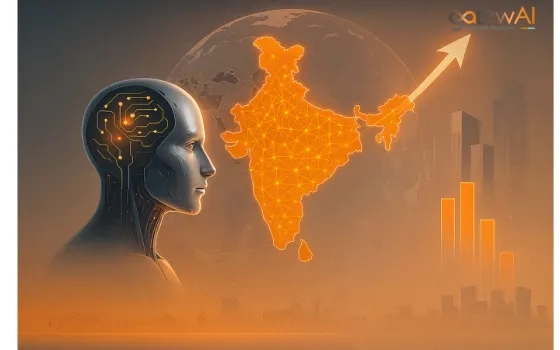
Over the last decade, India’s Global Capability Centres (GCCs) have quietly gone through the biggest transformation in their history — but 2025 is the year this shift becomes impossible to ignore.
What began as cost-saving offshore units has now become a global magnet for innovation, AI-driven decision-making, leadership development, and next-gen digital talent. And the world is watching — because India is no longer the place where work gets done.
India is becoming the place where world-changing work begins.
India today hosts 1,800+ GCCs, employing over 1.9 million professionals, and contributing more than $64 billion in value — a figure expected to touch $110 billion by 2030. Every month, new global companies announce their India centers, and existing ones double down on expansion, capability building, and leadership roles.
Why?
Because India now offers something no other country can:
the world’s largest, youngest, most future-ready digital workforce… combined with the fastest adoption of AI.
This combination has unlocked a new era — The Big Shift — where GCCs are no longer operational back offices but strategic engines that run the enterprise.
From Cost to Capability: India’s Workforce Has Evolved
GCCs were built for process delivery, ticketing, IT support, and back-office functions.
Companies started bringing analytics, cloud, cybersecurity, ERP, design, and engineering functions to India.
AI, machine learning, automation, and product ownership became the core focus. Now, we’ve entered something even bigger — the Leadership Era, where India owns global charters, product roadmaps, and end-to-end transformation mandates. This is not an evolution. This is a reset.
If talent built the foundation, AI is the power source accelerating the rise of India’s GCCs.
Today, GCCs are using AI to:
And here’s the game-changer:
AI is democratizing expertise.
A junior engineer is now as powerful as a mid-level engineer from five years ago. A GCC with 500 people can now deliver the capability of a 2,000-member team. This efficiency is why companies like Walmart, Airbus, Pepsico, Target, and Nike are expanding their India mandates at a record pace.
Traditional workforce models are no longer enough. GCCs now operate like mini-tech companies with flexible, hybrid, and AI-augmented teams.
1. Talent-as-a-Service (TaaS)
Companies can now plug in niche talent instantly instead of spending months on hiring. Perfect for AI, cloud, cyber, product engineering, and automation.
2. Multi-City Talent Hubs
The rise of Kochi, Coimbatore, Jaipur, Lucknow, Indore, and Ahmedabad marks the next GCC frontier. Why? Better cost, better retention, less saturation.
3. Skill-Based Hiring Over Degree-Based Hiring
If you can build, problem-solve, code, or ship — you’re in. This shift is attracting makers, creators, and innovators.
4. Continuous Upskilling & Leadership Tracks
78% of GCCs now invest heavily in AI, cybersecurity, cloud, and platform engineering training. Leadership academies, internal mobility, and cross-functional rotations are becoming the norm.
5. Experience-Rich Work Culture
Hybrid work, wellness, fast-growth roles, global exposure, and purpose-driven teams are redefining the GCC EVP.
In short —
Talent is not just being hired; it’s being shaped.
Why GCCs Are the Hottest Talent Market Today
Because they offer something unique:
Impact + Innovation + Stability.
This formula is why young professionals now prefer GCCs over big tech, startups, and consulting.
2025–2030: The Decade Where India Becomes the World’s GCC Superpower
The numbers tell the story:
| Metric | 2024 | 2030 (Projected) |
|---|---|---|
| GCC Count | 1,700+ | 2,200+ |
| GCC Workforce | 1.9M | 2.5–2.8M |
| Global Roles Managed | 6,500 | 20,000+ |
| Tier-II/III GCCs | 220+ | 400+ |
| Market Size | $64B | $110B |
This next phase of growth will be defined by:
→ Total shift to AI-first work models
Every team, role, and function becomes AI-enabled.
→ Mid-market companies becoming major GCC investors
More than 120 new GCCs expected in the near term.
→ India becoming a global leadership hub
Product heads, engineering directors, and P&L leaders are increasingly based in India.
→ Rise of end-to-end innovation out of India
ER&D, digital product studios, cybersecurity labs, and AI CoEs.
→ Stronger partnership between industry + academia + startups
IP creation, research labs, incubation centres — all driven from India.
This isn’t growth.
It’s dominance.
Conclusion: The Big Shift Is Not Just About AI — It’s About India’s New Identity
The Big Shift marks the moment India moves from being the world’s back office to becoming the world’s innovation headquarters.
With AI accelerating capabilities, Tier-II cities unlocking new talent, and GCCs transforming into strategic engines — India is shaping the next chapter of global business.
GCCs in India are no longer supporting global enterprises. They are steering them.
And as AI becomes central to every business model, India is perfectly positioned to lead the next decade of global transformation.